UST Training found this good summary of the 2018 deadline for the new EPA rules published by Peter J. Cochefski, Director of Ryder Fuel Services. Thanks Peter for sharing your perspective.
Oregon has the distinction of being the first state in the US to require UST operator training back in 2003 and instructor Ben Thomas has trained the majority of UST operators in Oregon since then. This course will prepare students to become a certified Class A/B UST operator in Oregon. Attend this lively, interactive class to learn about UST rules, best management practices and come away with practical advice about being a top notch UST operator. Seating is limited, sign up today!
The US EPA has published a handy list of resources for UST operators in case of natural disasters like flooding, tornadoes and storm events. Class A/B UST Operators should get these important documents and study them if you are in areas prone to potential natural disasters.
The 2017 edition of RP100: Recommended Practices for Installation of Underground Liquid Storage Systems (PEI/RP100-17) has been finalized and is available for purchase at www.pei.org/rp100. The price is $40 for members and $95 for nonmembers. The 2017 edition supersedes the 2011 edition of the document (PEI/RP100-11).
Last Friday the Washington Post ran an article with a detailed list of program cuts to the US Environmental Protection Agency (EPA). Needless to say I was surprised to see the nation’s underground storage tank (UST) program on the chopping block.
As someone who’s been been the UST industry three decades spending my career preventing leaking UST systems from polluting drinking water systems, the cuts I see are deep enough to render the UST program essentially non-functioning.
It’s a lot of budget lingo to wade through so I contacted Carolyn Hoskinson, head of the nation’s UST regulatory program at EPA Headquarters and asked what this means in real terms. According to her:
1.States would not receive pollution prevention funding
No funding for state staff to offer technical assistance or regulatory support.
No funding for state staff to do compliance checks and inspections.
2. Significant reduction in cleanup funding
Significant reduction of funds for leaking UST sites in Indian Country.
Significant reduction of funds for leaking UST sites to states.
Elimination of staff who oversee cleanup projects.
3. All but eliminate EPA HQ policy people
No more research.
No more policy interpretation.
No conferences, association meetings, newsletters, peer matches.
No one directing national policy on pollution prevention.
Reduced EPA staff to run compliance and cleanup in Indian Country.
Those who know this industry well know that the UST program is considered one of the most streamlined and effective environmental programs today. The UST program is based on 30 years worth of collaborative effort between Federal, state, tribal and local governments, tank testers, manufacturers, and technicians and of course UST owners and operators. It’s a great program, run well, with huge benefits to every single American.
So here is what I’m asking all my friends, colleagues, associates and clients:
If you believe the UST program has value in protecting human health and the environment, I am asking you to contact your local government representatives and ask they support not cutting this important program.
Also I’m attaching a 1984 segment of 60 Minutes so folks can know what the United States was like before we had a UST program.
Thanks in advance for your support,
Ben Thomas
UST Training
Keeping your drinking water clean since 1987
I was teaching a Class A/B UST operator training course in Portland, Oregon yesterday and one of the students said “Hey, did you hear about the gas station accident last night?” We looked it up online and shared and discussed the following tragic story
It’s a terrible story about a seemingly random accident that resulted in a fatality right before the driver struck dispenser. If you see the picture and watch the video in the link you’ll notice the dispenser basically explodes and the shear valve does not appear to have worked. Or did it? I’ve seen a few videos like this where the vehicle hit the dispenser so hard I have to wonder: are shear valves rated for high velocity impact? Or did this shear valve not work? Or did the fuel vapor above the shear valve catch fire?
Do you have a large number of class C UST operators? Are you frustrated with high turnover rates? Do you have your own in-house Learning Management System (LMS)?
Did you know we License our course software? For some UST owners, leasing our Class C UST operator training courseware is a very smart alternative that can save you time, money and effort.
For many years, the Wisconsin Small Business Environmental Assistance Program has mailed out hard copy calendars to remind gas station owners of daily, weekly, monthly compliance actions. This year they mailed out a two-year calendar for 2017 and 2018. It’s an awesome tool for Class A/B UST operators. From their web page:
We just discovered our friend Don Taylor at the Tennessee Department of Environment and Conservation is in a number of very good UST videos now available on YouTube. Topics include spill bucket inspections, rectifier readings, dispenser inspections and more. Ben Thomas of UST Training has been working with these folks since the early 1990’s and is happy to see more great technical advice still coming out of Tennessee. See them all here


 UST Training found this good summary of the 2018 deadline for the new EPA rules published by Peter J. Cochefski, Director of Ryder Fuel Services. Thanks Peter for sharing your perspective.
 Oregon has the distinction of being the first state in the US to require UST operator training back in 2003 and instructor Ben Thomas has trained the majority of UST operators in Oregon since then. This course will prepare students to become a certified Class A/B UST operator in Oregon. Attend this lively, interactive class to learn about UST rules, best management practices and come away with practical advice about being a top notch UST operator. Seating is limited, sign up today!
  The US EPA has published a handy list of resources for UST operators in case of natural disasters like flooding, tornadoes and storm events. Class A/B UST Operators should get these important documents and study them if you are in areas prone to potential natural disasters.
  This just in from PEI:
 Last Friday the Washington Post ran an article with a detailed list of program cuts to the US Environmental Protection Agency (EPA). Needless to say I was surprised to see the nation’s underground storage tank (UST) program on the chopping block.
 I was teaching a Class A/B UST operator training course in Portland, Oregon yesterday and one of the students said “Hey, did you hear about the gas station accident last night?” We looked it up online and shared and discussed the following tragic story
 Do you have a large number of class C UST operators?
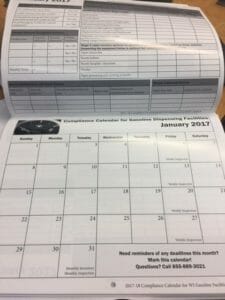 For many years, the Wisconsin Small Business Environmental Assistance Program has mailed out hard copy calendars to remind gas station owners of daily, weekly, monthly compliance actions. This year they mailed out a two-year calendar for 2017 and 2018. It’s an awesome tool for Class A/B UST operators. From their web page:
  We just discovered our friend Don Taylor at the Tennessee Department of Environment and Conservation is in a number of very good UST videos now available on YouTube. Topics include spill bucket inspections, rectifier readings, dispenser inspections and more. Ben Thomas of UST Training has been working with these folks since the early 1990’s and is happy to see more great technical advice still coming out of Tennessee.
