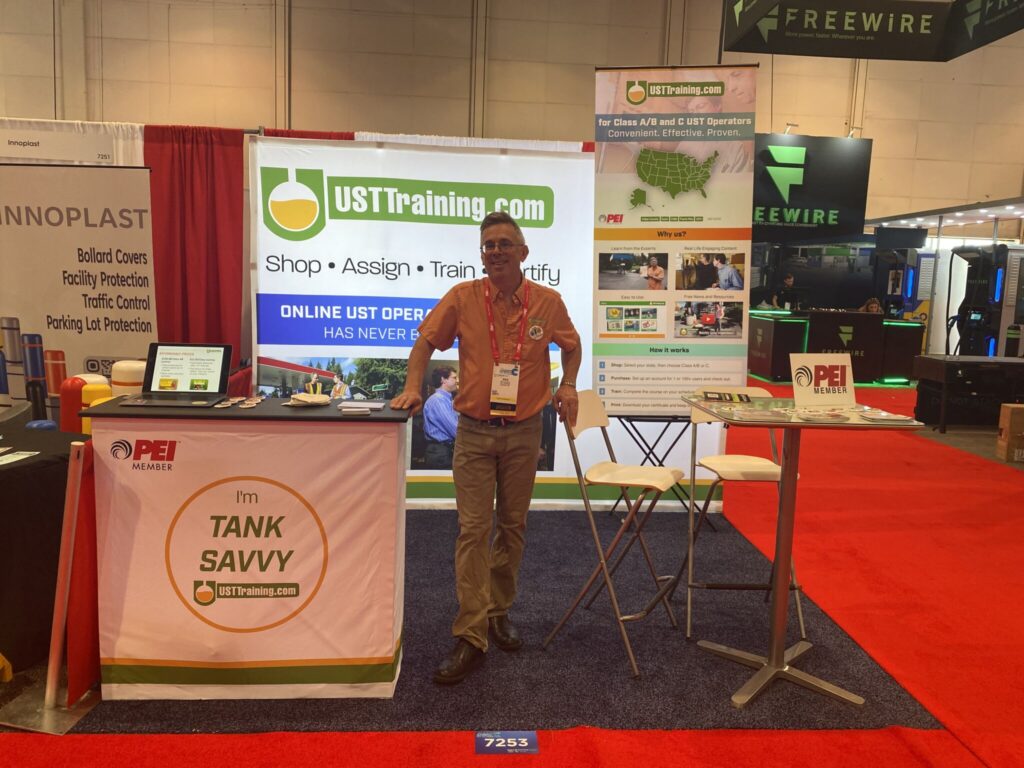
From the desk of Ben Thomas, President, USTtraining.com
One of the highlights of my career has been watching the growth evolution of UST operator training. Being the first person in the US to train and certify state-approved Class A/B UST operators, I’ve seen the industry grow from literally myself and a few others in Oregon to what seems like a sprawling array of choices nationwide. The old days of suffering through PowerPoint slides, heavy 3-ring binders, and hotel coffee and donuts all seem like a thing of the past. By now, the arm-chair convenience and mass scalability of online learning should be self-evident. Plus online learning appears to be generally accepted by the regulatory community as well as most Class A/B and Class C UST operators.
The good news:
- Millions of people have been trained to keep UST systems safe.
- UST compliance seems to be slowly improving nationwide.
- Environmental safety features have been modernized at many, if not most, UST systems.
- Online training has allowed UST owners with high staff turnover to train lots of people rapidly with minimal time and impact.
However,
With advances in various e-learning software programs, pretty much anyone (or any AI bot, yikes!) can create training to meet the minimum standards. I’ve noticed a slew of new UST training courses online where it’s impossible to determine who (or what) created them. So, are these digital Johnny-come-lately’s the equivalent to real life subject matter experts? Do they improve compliance? Do they inspire operators to do a better job? Is the knowledge gained actually retained and put into practice? And maybe most fundamental – do they call you back if you have a question about your UST system?
Whether you’re a savvy consumer, or a thoughtful regulator, consider the following when assessing online Class A/B and C UST operator training.
- Confirm agency approval. From time to time I see a training provider boast of agency approval in a state or territory that either hasn’t approved them or doesn’t approve any vendor at all. For instance, we discovered a trainer providing unauthorized (not agency approved) training in the US Virgin Islands. All the people that took their training lost their money and had to pay again and retake approved training. In another case, in California we’ve noticed a vendor providing online class UST employee (Class C) operator training, but not stating that the course is not approved in CA. The UST owner or certificate holder may be subject to regulatory action if found out. Always have the vendor verify (preferably through the agency approved-vendor webpage) that the training is approved in your state or territory. And state regulators: make sure all proof of training is cross-referenced to your approved list.
- State specific rules matter. Over the years we’ve been keenly aware that inspectors really don’t appreciate seeing federal UST rules in a training course where state rules apply. Ultra generic training is a reflection of how little time the vendor spent in creating state-specific content for you in the first place. It’s like a cheap date. Verify that the training content is not just for federal requirements, but covers the many varieties of state-specific rules. Only Indian country UST systems are subject to Federal law. The rest must abide by state specific rules.
- Who is the trainer? We’re starting to see the emergence of a number of online courses where it is impossible to identify the authors behind the content. The fact that anyone can take UST regulations and run them through a PowerPoint-like app or ChatGPT and spit out a training program to meet the minimum requirements should be of great concern to anyone interested in quality training. If you cannot verify an individual or company providing the training, there’s probably no one to talk to you if you have a question about the training itself or further regulatory clarification afterwards. It might be too late if you’ve taken a course that is generic, but be on the lookout.
- Use a reputable company. Training companies can come and go, so make sure to use someone who has a solid reputation in the UST industry. Companies such as ours have been doing operator training for over 23 years and our customers get the benefit of our years of expertise added to the training content. Reputable trainers are entering into a long-term relationship with you, providing guidance, support, and overall goodwill. Non-reputable ones are just selling you certificates, which is a nice way of saying they really don’t care about you. Work with a company who has verifiable UST expertise. Ask around and get references.
- Training should inspire and direct. Underground Storage Tank operator training is not just about the rules and regulations. It’s also about motivating operators to do required actions. It should help people understand:
- what to do
- when to do it
- how to do it
- and most importantly, why we’re all doing this in the first place.
If the training doesn’t motivate you in the action to assign and track responsibilities, you’re wasting your money. If your UST training does not include these important ingredients, then it’s probably not going to have the desired effect of improving your bottom line by improving UST compliance. Ask yourself, or your team if the training inspires you to do a better job. If not, keep shopping.
- And lastly, accept no imitations. The problem with being first in the industry is that we essentially (or unwittingly) set many standards where standards previously didn’t exist. I know that imitation is supposed to be the highest form of flattery but sometimes I see content that seems suspiciously like ours, structurally or literally. Which, to be blunt, is theft. For instance, we recently discovered a training course that was effectively our course reconstructed. It wasn’t an exact cut and paste, but there is no way this course could exist without having first viewed ours. There are too many coincidences for them to come up with their course independently. In another example, around 2007, we came up with the idea of a site-specific worksheet to help class C UST operators better understand safety equipment at their particular site. Since that time we’ve seen an explosion of use of our form in various guises, but it is essentially comes back to the form I created all those years ago. Please let us know if you come across training that looks like ours so we can take appropriate legal action.
We recognize that there are lots of other non-UST requirements on the shoulders of owners and operators outside of the Class A/B and C certification. Alcohol sales, tobacco sales, food handling… the list goes on. So we understand that the typical operator isn’t necessarily doing the deep-dive research required to get the best bang for the buck. And even though many might prefer just to get the certificate and be done with it, it’s a smart business decision to take a little bit of time to study your options, read reviews, talk to real live operators, and narrow down your choices. It can be one of the best decisions you can make to avoid shut down, fines, or leaks, and spills. So be Tank Savvy!
Want to learn more about why we are different than others?
