Another Dispenser Shear Valve Saves the Day
Next live OR/WA Class A/B course June 1 in Portland
 Oregon has the distinction of being the first state in the US to require UST operator training back in 2003 and instructor Ben Thomas has trained the majority of UST operators in Oregon since then. This course will prepare students to become a certified Class A/B UST operator in Oregon. Attend this lively, interactive class to learn about UST rules, best management practices and come away with practical advice about being a top notch UST operator. Seating is limited, sign up today!
Read More →
 The US EPA has published a handy list of resources for UST operators in case of natural disasters like flooding, tornadoes and storm events. Class A/B UST Operators should get these important documents and study them if you are in areas prone to potential natural disasters.
 PEI RP 100 Updated
 This just in from PEI:
The 2017 edition of RP100: Recommended Practices for Installation of Underground Liquid Storage Systems (PEI/RP100-17) has been finalized and is available for purchase at www.pei.org/rp100. The price is $40 for members and $95 for nonmembers. The 2017 edition supersedes the 2011 edition of the document (PEI/RP100-11).
Read More →
UST Federal Funding in Peril: Please Read
 Last Friday the Washington Post ran an article with a detailed list of program cuts to the US Environmental Protection Agency (EPA). Needless to say I was surprised to see the nation’s underground storage tank (UST) program on the chopping block.
As someone who’s been been the UST industry three decades spending my career preventing leaking UST systems from polluting drinking water systems, the cuts I see are deep enough to render the UST program essentially non-functioning.
Here is the full article.
New EPA documents reveal even deeper proposed cuts to staff and programs
And here is the 64-page of program cuts. See pages 16-18 about the UST items.
It’s a lot of budget lingo to wade through so I contacted Carolyn Hoskinson, head of the nation’s UST regulatory program at EPA Headquarters and asked what this means in real terms. According to her:
1.States would not receive pollution prevention funding
- No funding for state staff to offer technical assistance or regulatory support.
- No funding for state staff to do compliance checks and inspections.
2. Significant reduction in cleanup funding
- Significant reduction of funds for leaking UST sites in Indian Country.
- Significant reduction of funds for leaking UST sites to states.
- Elimination of staff who oversee cleanup projects.
3. All but eliminate EPA HQ policy people
- No more research.
- No more policy interpretation.
- No conferences, association meetings, newsletters, peer matches.
- No one directing national policy on pollution prevention.
- Reduced EPA staff to run compliance and cleanup in Indian Country.
Those who know this industry well know that the UST program is considered one of the most streamlined and effective environmental programs today. The UST program is based on 30 years worth of collaborative effort between Federal, state, tribal and local governments, tank testers, manufacturers, and technicians and of course UST owners and operators. It’s a great program, run well, with huge benefits to every single American.
So here is what I’m asking all my friends, colleagues, associates and clients:
If you believe the UST program has value in protecting human health and the environment, I am asking you to contact your local government representatives and ask they support not cutting this important program.
Also I’m attaching a 1984 segment of 60 Minutes so folks can know what the United States was like before we had a UST program.
Thanks in advance for your support,
Ben Thomas
UST Training
Keeping your drinking water clean since 1987

Did the shear valve work?
 I was teaching a Class A/B UST operator training course in Portland, Oregon yesterday and one of the students said “Hey, did you hear about the gas station accident last night?” We looked it up online and shared and discussed the following tragic story
Man hit before gas station inferno crash has died
It’s a terrible story about a seemingly random accident that resulted in a fatality right before the driver struck dispenser. If you see the picture and watch the video in the link you’ll notice the dispenser basically explodes and the shear valve does not appear to have worked. Or did it? I’ve seen a few videos like this where the vehicle hit the dispenser so hard I have to wonder: are shear valves rated for high velocity impact? Or did this shear valve not work? Or did the fuel vapor above the shear valve catch fire?
Comments welcome.
Our Class C UST Operator License Program: Is it for you?
 Do you have a large number of class C UST operators?
Are you frustrated with high turnover rates?
Do you have your own in-house Learning Management System (LMS)?
Did you know we License our course software? For some UST owners, leasing our Class C UST operator training courseware is a very smart alternative that can save you time, money and effort.
Read More →
Wisconsin Mails Out 2017-18 UST Compliance Calendars
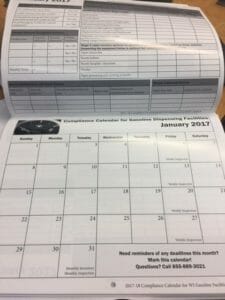 For many years, the Wisconsin Small Business Environmental Assistance Program has mailed out hard copy calendars to remind gas station owners of daily, weekly, monthly compliance actions. This year they mailed out a two-year calendar for 2017 and 2018. It’s an awesome tool for Class A/B UST operators. From their web page:
Read More →
Training Videos Courtesy of Tennessee
 We just discovered our friend Don Taylor at the Tennessee Department of Environment and Conservation is in a number of very good UST videos now available on YouTube. Topics include spill bucket inspections, rectifier readings, dispenser inspections and more. Ben Thomas of UST Training has been working with these folks since the early 1990’s and is happy to see more great technical advice still coming out of Tennessee. See them all here
 Eight years ago in Colorado we launched the nation’s first state-approved online Class A/B UST operator training course. Since then we’ve grown to offer Class A/B training in a number of states. So how are we doing?
 UST Training Now Offers Class A/B Training in Georgia
 Hello Georgia Class A/B UST operators! Our course is now online and approved by the Georgia Environmental Protection Division. Learn more now
Overview:
Georgia Class A/B UST operator training course is a great way to meet the training requirements while learning everything you need to know to be an effective UST operator.
Self Paced:
This option allows users to watch 10 lessons online instead of attending a live webinar. Users take each lesson any time that is convenient. Great for new and experienced operators alike. Total lesson viewing time is about 3 hours. Plus a 1-hour final exam.
Read More →
EPA’s UST Performance Measures
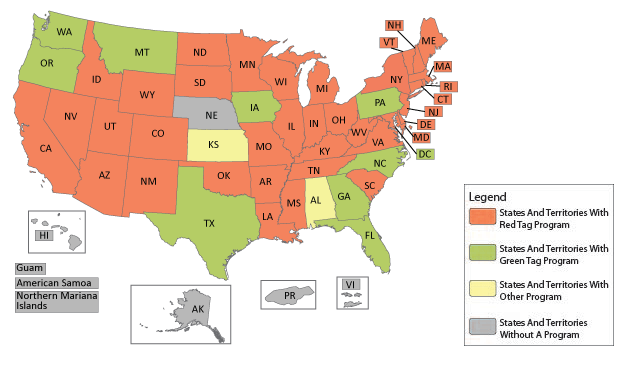 The US EPA just published what is effectively the State of the Nation for Underground Storage Tank Systems for activities from October 1, 2015 through September 30, 2016. How did you do in your state or region?
Latest LUSTLine issue now available
 Hi UST Class A/B Operators. Did you know there is a national newsletter about UST systems called LUSTLine? Check out the latest edition online.
Great topics include:
- Emerging Contaminants and Shallow Groundwater
- Corrosion in Underground Tanks Storing Diesel
- Untangling UST Corrosion Issues
- Field Notes: Lament, a Few Excuses…
- There’s a Hole in the Bucket…
- Using Environmental Covenants/Site Closure
- Why States Should Be Concerned About Aging Tanks
- Former TN Gas Station is Transformed
Our Group Accounts Just Got Easier
 If you are a UST owner, let’s say you need training for 3 Class A/B UST operators and 10 Class C UST operators. Good news — you can now set up a simple group account in just a few minutes.
We recently enhanced our group account setup. Now, any number of users can take any number of classes.
Our new account options:
Single User is perfect for one person to take Class A/B or Class C training or both.
User email required.
Training Kiosk is a great option for small to medium group of users who need any combination of Class A/B or Class C training.
Email required for account administrator only.
Single login credential shared for the whole group.
Course Library is good for medium to larger companies with a mix of Class A/B and/or C operators who also need more advanced reporting and tracking features.
Email required for all users.
Each user has own login credentials.

Need a National UST Training Solution?
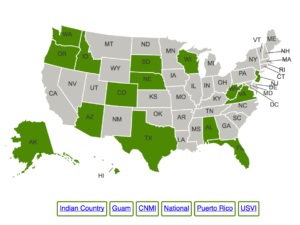 UST Training may not be approved to offer Class A/B Training in every state and territory but we do have state-specific solutions for UST operators looking for the best possible option.
Using our three decades of UST expertise and our position as industry leaders in UST training, we are happy to guide you to the best option based on your company need and who we think the best state-specific choices are.
We are part of an informal network of national training solutions so let us make a referral for you. Need solutions in a large number of states? We have them. Just click on any Class A/B state and follow the instructions.
Contact us at [email protected] or 866-301-8265.
1984: The Beginning of UST Awareness
In August of 1984, the TV show 60 Minutes ran what would become the story that woke America to the hazards of unregulated UST systems. Today UST operators, and anyone downstream of a UST system, have much to be thankful for when this show blew the lid off what would become “the environmental issue of the ’80s.”
If you need any appreciation as to how far we’ve come as an industry, this story (with its impacted elders, its lack of of science, its evasive executives) illustrates the evolution of risk management of an entire sector of society. Starting with denial, then assessment, then awareness, and now, today: of course, ongoing education, in part through the efforts of myself and thousands of UST professionals nationwide. Enjoy this awesome piece of historical perspective.
And be on the lookout for UST legend Warren Rogers, who I knew only briefly but am indebted to for all he did for detecting leaking USTs.
A Case of Phase Separation?
 Here’s an interesting story of a number of stalled out vehicles that all filled up at the same gas station one day recently. One suspect, ethanol-driven phase separation, was not mentioned…
Cars break down after filling up at Redmond gas station
UST Operators, don’t forget to measure for water!
Next Oregon Class A/B UST Training January 10, 2017
The next Oregon Class A/B UST Operator Training class is set for Tuesday March 10, 2017, 8 AM to 4 PM.
Oregon has the distinction of being the first state in the US to require UST operator training back in 2003 and instructor Ben Thomas has trained the majority of UST operators in Oregon since then. This course will prepare students to become a certified Class A/B UST operator in Oregon (Washington operators welcome too!). Attend this lively, interactive class to learn about UST rules, best management practices and come away with practical advice about being a top notch UST operator.
Oregon Class A/B UST Operator Training
George Fox University, 12753 SW 68th Avenue
Portland OR 97223-8305
Hawai’i Class A/B UST Training in March 2017
 Aloha Hawai’i UST operators.
Are you interested attending a live classroom Class A/B UST operator training in March of 2017?
We offer our course online but some folks prefer the interaction of a live classroom.
I’ll be in Oahu in March so I thought I’d see if there’s any interest. I did a class last year in Maui and it was very well received. Currently I’ve got some interest in Oahu, Maui and the Big Island but I’d be happy to go to any island with a large enough group.
Dates would be sometime during March 20–24, 2017.
If you are interested please tell me:
- What island you’d like to see training on?
- For how many people?
- Do you have a training room you’d be willing to offer in exchange for a training discount?
Please call Ben Thomas at 866-301-8265 or email if you’d like to discuss further.
Mahalo!
From the PEI Show at NACS: What’s New?
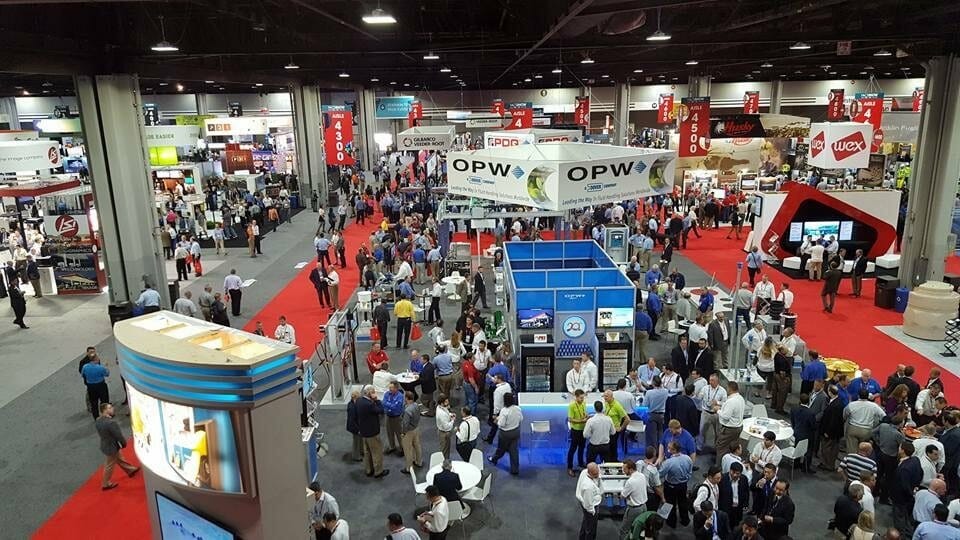 Ben Thomas of UST Training recently returned from the PEI Trade Show in Atlanta with lots to share about what’s new in the world of UST systems. PEI reported that 1,575 attendees visited 641 booths and 245 educational sessions. The show, including the NACS side, is so big that attendees never really get to all the booths and can’t spend enough time at each one to feel like they’ve “seen it all.” Even so, there are some major (and minor) things to report back to UST professionals including Class A/B and C UST operators.
Read More →

