Why have a team account?

Why have a team account?
Choosing the best plan
With our new and improved LearnSavvy system, you can shop for Class A/B and C UST operator training:
- For yourself
- For someone else
- For a small or large group
Go Team!
When shopping for more than one person, a team account may be for you. Even if you operate just one location and need only one Class A/B license, you’ll still likely need to train anywhere between 2-10 Class C operators.
Read More →
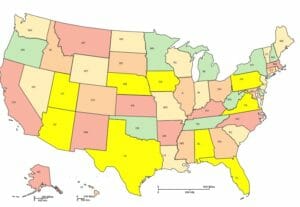
Want to train every UST operator in your state? Let’s talk
At UST Training we’re not just here for answers; we want to give you solutions. The former is the bare bones of “get ‘er done”; the latter is looking ahead and putting the problem into the context of tackling your long term goals.
Which is why we offer big things like training an entire state or Territory. For example, under contract with the Arizona Department of Environmental Quality (ADEQ), we’ve been offering online training to all qualifying Class A/B or C UST operators in the Grand Canyon State.
Since October 2020 we’ve certified over 550 Class A/B UST operators and over 1,000 Class C UST operators. That’s training a little over 1 Class A/B operator and 2 Class C operators per day, including holidays and weekends. And all 100% online. No travel, no classroom logistics, no extra binders for no-shows, no lukewarm coffee at the break. The ADEQ reimburses UST Training for every completed course. UST Training provides the training online including all hosting, tech support and reporting. We’ve also trained all the UST operators in Guam, CNMI and the US Virgin Islands.
If you work for a state UST agency and would like to upgrade your existing solution with an eye towards improving UST compliance on a large scale, give us a shout at 866-301-8265 or [email protected].
Let’s talk.

Now Available: Video to Help You Prepare for Arizona DEQ Inspections
ADEQ inspectors can help you protect your investment in Arizona by identifying operating conditions that could lead to environmental contamination. Preventing releases from your UST system means avoiding lost inventory and the need for costly cleanup actions.
ADEQ wants you to be well-prepared for your next UST inspection, which could mean a shorter inspection with less business interruption for you and fewer deficiencies.
Click to watch video on YouTube >
Read More →

Release Detection for Underground Storage Tanks and Piping: Straight Talk on Tanks
Here’s an updated version of the famous original that dates back to the 1990s. This booklet helps Class A/B UST operators understand the different leak detection methods for UST systems.
(EPA 510-K-20-002). August 2020.
This booklet provides easy-to-understand descriptions of several release detection methods for tanks and piping, as well as explanations of the regulatory requirements for release detection. Release detection methods include: secondary containment with interstitial monitoring, automatic tank gauging, continuous in-tank leak detection, statistical inventory reconciliation, tank tightness testing with inventory control, manual tank gauging, groundwater monitoring, vapor monitoring, and release detection for underground piping.
UST System Compatibility with Biofuels
(EPA 510-K-20-001). July 2020.
This 21-page booklet discusses the 2015 UST compatibility requirements for tank systems storing biofuels and petroleum-biofuel blends. The booklet presents actions for minimizing the risk of a release from UST systems due to incompatibility.
PEI RP 900
Big news for states who require this form or any UST Class A/B who uses this super helpful 30-day inspection form. Ben Thomas of UST Training is proudly serving on this committee.
PEI RP900-21 was finalized and published at the end of December 2021. The updated practice is now available for purchase on TechStreet through PEI’s website at www.PEI.org/rp900.
I would like to personally thank Chairman Brad Hoffman and each of the committee members for your dedication and service to make RP900-21 a great practice and a useful resource for the petroleum industry.
Best Regards,
Scott C. Boorse
Director of Technical Programs & Industry Affairs
918.236.3975 | 610-513-6542 | Tulsa, OK

What Our 2022 Looks Like
Even with the pandemic’s impacts on business and life in general in 2021, our team at UST Training had an amazing year, helping UST operators learn about proper alarm response, avoid common violations, keep their communities safe from leaking UST sites, and of course get state-certified as Class A/B and C UST operators.
What will 2022 look like? We plan to:
- Expand our Class A/B course offering in the few remaining states we’re not yet approved in.
- Revise, tweak and update our existing Class A/B courses.
- Attend a growing number of trade shows and conferences (masked if required, vaccinated regardless).
- Train even more operators in the states where we offer free training (Arizona and Iowa).
- Train state and Federal UST inspectors via scheduled webinars.
- Expand our License program for companies who have lots of Class C’s to train and need an in-house, cost-effective solution.
- Increase our Affiliate program, allowing companies to make passive income selling our A/B and C courses.
- Provide more UST community building on our Friday Tank Savvy chat’s.
- Look for ways to improve our products based on customer feedback.
- Offer multi-state solutions for companies with lots of USTs in different states.
- Create more Tank Savvy Minute videos.
How can we help YOU be a better UST owner, operator or inspector? Let us know.

CT Adopts New UST rules
Good news from my home state of Connecticut. The DEEP adopted UST rules in December 2021 and take affect pretty much right now. We’re updating our CT Class A/B UST Operator Training course to reflect these new changes which include:
- Testing spill buckets every 3 years.
- Removing all ball float valves by 2022.
- Release detection for emergency power generator USTs.
- (Interestingly) the prohibition of field-constructed tanks and certain airport hydrant systems.
- Extra testing requirements for spill buckets, sumps and overfill devices.
- Testing sumps every 3 years instead of every 5 years.
- Additional requirements for record keeping for E10+ and B20+ fuels.
Our revised course is being submitted and should be updated soon.
Any CT UST rule questions, please contact us.
UST Inspectors Need Training?
Need State or Federal UST inspector training this upcoming year? But concerned about potential travel restrictions due to Covid-19 in 2022?
We’ve got a simple solution: Live, interactive webinars for you and your team of UST inspectors.
Ben Thomas of UST Training is one of the few UST operator trainers who also provides training for UST inspectors at a state, regional or even national level. Last year Ben offered many webinars across the US that were very well attended and well received.
Ben can work with groups of any size: from a small handful to over 100. He also offers anything from one-hour to 5 days, depending on the topics you want covered. He’s happy to use whatever platform you prefer: Zoom, Teams, WebEx or others.
Interested? Contact Ben at 360-3214776 or [email protected]
When Even Big Companies Ignore Alarms…
You know if a large company can be found to be ignoring the warning signs of a big leak, then certainly you, the corner convenience store owner, can too.
Texas pipeline company charged in California oil spill
So, please: if your tank monitor says anything other than “all functions normal” verify you know what the blinking red light means. If you’re not sure, contact your supervisor or petroleum service provider. If it looks serious, contact someone right away.
We go to great lengths in our Class A/B UST operator training classes to explain what alarms mean and why immediate response is necessary. Remember: Your mission is not to end up as one of our stories.
More Tank Savvy Talks in 2022
Due to popular demand, we’ve added a number of new dates through March 2022 for our Friday Tank Savvy Talks with Ben Thomas, President of UST Training and author of the nationally recognized Tank Savvy Minute Videos on YouTube:
Sign up today for some or all of the dates
Read More →
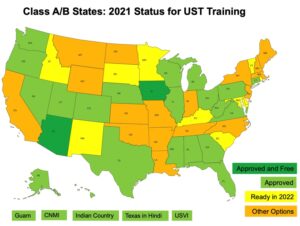
Class A/B Training: 28 States and Growing
If you’re a Class A/B UST operator in just one state with a few UST sites, you may not know that each state has different operator training rules. And because each state has its own unique spin on the Federal UST requirement, each state has a different approach to how UST operators get trained.
Which is a lot of rules to keep track of.
(See related articles by Ben Thomas and Marcel Moreau in LUSTLine)
What’s required is literally all over the map and we at UST Training offer online Class A/B and C training in nearly all states that allow it. Soon we should be in all allowable states and territories.
Read More →
Over 500,000 Underground Storage Tank Releases Cleaned Up
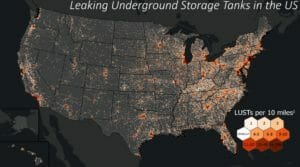
This just in from EPA. In the span of my 34 years in the UST world, we’ve completed a half million leaking UST site cleanups. A major milestone. – Ben
Dear UST Colleagues:
I am writing to tell you about EPA’s announcement that over 500,000 underground storage tank (UST) releases have been cleaned up.
Over 500,000 Underground Storage Tank Releases Cleaned Up
Read More →

Submit an Abstract for the 2022 National Tanks Conference
Attention UST operators, inspectors and service technicians:
The 27th National Tanks Conference (NTC) will take place September 13-15, 2022 at the Wyndham Grand in Pittsburgh, Pennsylvania. NEIWPCC is proudly co-sponsoring the NTC in partnership with U.S. EPA’s Office of Underground Storage Tanks (OUST) and the Association of State and Territorial Solid Waste Management Officials (ASTSWMO).
Read More →
Updated RP900 Reflects New Inspection Practices
Attention Class A/B UST Operators who use PEI RP 900 for 30-day walkthrough inspections. This just in from the Petroleum Equipment Institute:
An updated PEI RP900:Recommended Practices for the Inspection and Maintenance of UST Systems will be available for purchase in December. The Environmental Protection Agency (EPA) recognizes RP900 as a code of practice that may be used to comply with walkthrough inspection requirements in 40 CFR 280.36 (a)(2). Among other things, the revised RP900 includes updated monthly and annual inspection requirements that mirror EPA requirements. The daily inspection requirement was removed and made optional, and the monthly inspection process was modified to reflect the removal of the daily inspection requirement.
In plain English: RP 900 has a daily, monthly and annual inspection form. You no longer have to use the daily and annual inspections forms when using the monthly form unless you want to.
UST Training’s president Ben Thomas is on the PEI RP 900 committee and has been supporting this change for some time. Ben has been offering the RP 900 monthly form to Class A/B UST operators nationwide since before states even required the walkthrough inspection. Ben encouraged all UST operators use the monthly form when applicable or required and, especially for busy or complex UST sites to use the daily and annual form.
Any questions about RP 900? Email Ben anytime.
Helpful Inspection Video for 30-Day Walkthrough Inspections
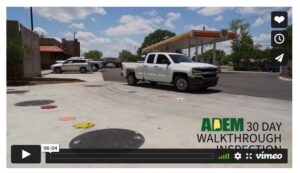
The Alabama Department of Environmental Management (ADEM) has this produced brief, helpful videos to help UST operators know how to perform a 30–day walkthrough inspection.
And our friends at the the Petroleum & Convenience Marketers of Alabama (PCMALA) have linked to the course as well. Check it out!
Even if you’re not in Alabama, you’ll find this video very useful.
And special thanks to PCMALA, who is an authorized affiliate of our online Alabama Class A/B and C UST operator training.
Wayne Geyer Inducted in Steel Tank Hall of Fame
Read More →

News Flash: LearnSavvy Has Arrived
USTtraining.com is excited to announce LearnSavvy — it’s our new way to take, assign and manage your Class A/B and C training.
It’s the same great high-quality UST operator training courses as before: now just better, stronger and faster. And because it’s designed specifically for you, the UST operator, it’s also easier than ever.
Based on decades of experience working with UST operators like you, LearnSavvy will help you train your team faster, easier, and better. Benefits include:
Read More →

Need Help Changing Your Dispenser Filters?
PEI, the Petroleum Equipment Institute has some super helpful videos for UST technicians (and UST operators who’ve been properly trained) to change filters. Check it out!
